How to Refinance a CHFA Loan in Colorado
CHFA subordinates its down payment second exactly once, and only into its own FHA Streamline. Every other refinance has to pay it off in full at closing, and that one rule decides whether yours works.
 Matt WentzAugust 16, 2026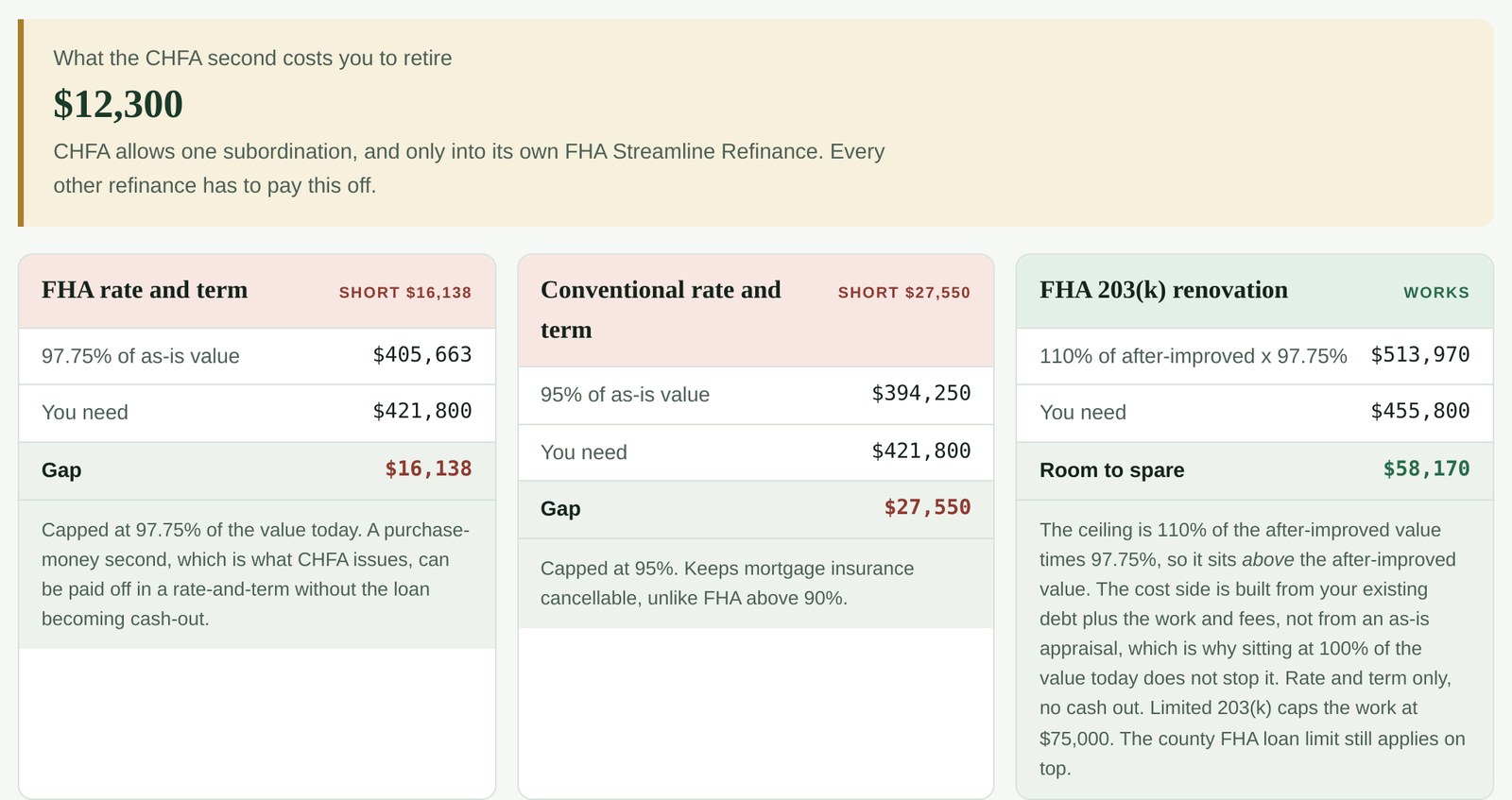
Refinancing a CHFA loan is not like refinancing a normal one, because of the second mortgage sitting behind your first. CHFA will subordinate that second exactly once, and only if you refinance into CHFA's own FHA Streamline Refinance. Refinance into anything else, with any other lender, and the second has to be paid off in full at closing.
That single rule decides almost everything about whether your refinance works. It is also the part most loan officers discover three weeks into the file, when the payoff demand comes back and the numbers stop working.
Should you refinance at all right now?
For most CHFA borrowers today, no. If you bought with CHFA in 2020 or 2021, your first mortgage is somewhere in the threes and nothing available now comes close. If you bought in 2023 or 2024, you are probably in the sixes or low sevens, and the case gets more interesting, but it still has to clear the cost of retiring the second.
The honest filter is this. Add up what it costs to refinance, including paying off the CHFA second, and divide by what you save each month. If that number is longer than you plan to stay in the house, the refinance is a loss no matter how much better the rate looks.
What actually happens to the CHFA second
CHFA's down payment assistance second is a deferred loan. No monthly payment, nothing due, until one of a short list of events happens: you sell, you pay off the first mortgage, you stop living in the home as your primary residence, or you refinance.
Refinancing is on that list. It is the piece people miss, because a second with no payment feels like it is not really there until the day you try to move the first mortgage out from under it.
Three things to establish before anything else:
- Is it a second mortgage or a grant? CHFA has issued both. A grant is not repaid and does not stand in the way. A DPA second is a recorded lien and does.
- Is it a HomeAccess second? Those are not eligible for subordination at all, under any circumstances.
- Is it Schools to Home? That one is shared appreciation, and it deserves its own section below.
Option one: CHFA's FHA Streamline Refinance
If your first mortgage is an FHA loan serviced by CHFA, this is the path that leaves the second where it is. CHFA allows a one-time subordination of the DPA second to a new CHFA first mortgage under their streamline program, which means you lower your rate without having to produce the money to retire the second.
Note the word once. If the second has already been subordinated in a previous refinance, that option is spent.
The tradeoff is that you stay inside CHFA. You get their rate on that day, on their program, with their servicing. If the market has a materially better option, you cannot take it and keep the subordination.
Two practical limits come with it. Closing costs cannot be financed on a streamline unless a current appraisal is obtained, so plan on paying them at the table or taking a higher rate so the lender can credit them. And ordering that appraisal is self-defeating in a falling market, because it caps the loan at 97.75% of the new value, which is the exact problem a streamline exists to sidestep.
The same logic is what makes a streamline with any other lender an option worth pricing. No appraisal is ordered there either. The catch is that CHFA will not subordinate outside its own program, so the second has to be paid off in cash before that loan can close.
Option two: a rate and term refinance that pays the second off
This is the main path for anyone with equity. Your new first mortgage is written large enough to retire both the existing first and the CHFA second, and the second disappears from your title.
Paying off the CHFA second does not make this a cash-out refinance. FHA allows a rate and term refinance to include the payoff of a purchase money junior mortgage with no seasoning requirement at all, and Fannie Mae's limited cash-out rules work the same way for a subordinate lien that was used to buy the property. That distinction matters, because cash-out pricing and cash-out loan-to-value limits are both worse.
The ceiling is what stops people. FHA rate and term tops out at 97.75% of the current appraised value. Conventional rate and term tops out at 95%. Add your first mortgage balance, the CHFA second, and the closing costs, and if that total lands above the ceiling, this door is closed.
Option three: leave it alone
Underrated, and frequently correct. A deferred second at zero percent with no monthly payment is not costing you anything month to month. It comes due when you sell, and if you are going to sell in a few years anyway, paying a few thousand dollars in closing costs today to retire it early accomplishes very little.
The exception is if you need the second gone for a reason other than the rate. Removing it clears the title for a future HELOC, and it ends the shared appreciation clock if you have Schools to Home.
If you have Schools to Home, read this before anything else
The Schools to Home second is not a fixed balance. It is repaid along with a fixed share of the home's appreciation, and that share is the original second divided by the original purchase price. Buy at $400,000 with an $80,000 second and your share is 20% of every dollar of appreciation.
Refinancing triggers that repayment exactly the way selling does. You are not taking money out, you are not moving, and the appreciation share still comes due in cash at closing.
On a home that has gained $60,000 since purchase, a 20% share is $12,000 on top of repaying the second itself. That is the number to run before anyone starts shopping rates, and it is the reason most Schools to Home borrowers should stay put unless something has changed materially.
When there is not enough equity: the renovation refinance
This is a narrow option and it is not for most people, but very few borrowers know it exists, so it is worth understanding.
The problem it solves is the one above. Your first plus the CHFA second exceed 97.75% of what the house is worth today, so a standard rate and term cannot cover the payoff. You are not underwater exactly, but you are close enough that no ordinary refinance reaches.
An FHA 203(k) rehabilitation refinance is built differently, and the difference is the whole point. It finances 100% of what you owe plus the cost of the work. A standard FHA refinance finances 97.75% of what the house is worth.
Your mortgage amount is your existing debt on the property plus the financeable repair costs, mortgage fees and contingency reserve, taken at full value rather than reduced to a percentage of an appraisal. There is a backstop at 110% of the after-improved value multiplied by 97.75%, and the county FHA loan limit sits over everything, but on a normal file neither one binds. The number that matters is what you owe plus what the work costs.
Read that again, because it is the part that gets misquoted. The loan is not a percentage of an appraised value at all. It is your actual debt plus your actual costs, financed in full. Being at or above 100% of what the house is worth today does not disqualify you the way it does everywhere else, because value is not what the loan is measured against.
The 110% line is a backstop, not an allowance. You cannot borrow up to it, because there is nothing to fund with the difference. If your debt plus the work happens to exceed it, the scope comes down until it passes, or the deal does not happen. On most files it never comes up.
So the transaction becomes one new first mortgage that retires the old first, retires the CHFA second, and funds the renovation, all in one loan, with the appraisal written subject to the completed work.
Which 203(k) this is, and where the line sits
A scope like this is a Limited 203(k), and the Limited version is where the boundaries matter, because staying inside them is what keeps the file simple and the timeline short. FHA moved that line recently. Mortgagee Letter 2026-06, issued June 23, 2026, rewrote how a repair gets classified as major, which is what disqualifies work from the Limited program.
Under the current rule a repair is major, and therefore ineligible for a Limited 203(k), when any one of these is true:
- The work is expected to take more than nine months.
- The rehabilitation requires more than four draws per contractor. That was raised from two, which is the substance of the June 2026 letter.
- Repairs arising from the appraisal need a consultant to write the specification, or need plans or architectural exhibits.
- The work prevents the borrower from occupying the home for more than 30 days total.
The rehabilitation cost limit is $75,000, raised from $35,000 by Mortgagee Letter 2024-13 for case numbers assigned on or after November 4, 2024. Plenty of published material still quotes the old number.
Cross any one of those lines and the file becomes a Standard 203(k). That is not a disaster, but it brings a HUD consultant, a formal work write-up, a twelve month window and a heavier process. For a borrower whose goal is retiring a silent second rather than remodeling, staying in the Limited version is usually the point.
The appraisal is what actually kills these deals
This matters more right now than the arithmetic does. A standard rate and term refinance requires a fresh as-is appraisal, and the loan is capped at a percentage of whatever that appraiser writes down. Values have been falling across Colorado, not in one metro, so that number is coming back lower than owners expect from the Front Range to the Western Slope. A refinance that pencilled on last year's value does not pencil on this year's.
A borrower who bought with CHFA in 2023 or 2024 with minimal money down is the exact person this catches. They have paid down very little principal, they still carry the CHFA second, and the value that used to cover both has moved the wrong way. The appraisal comes back, the payoff no longer fits under 97.75%, and the file dies.
The 203(k) does not have that problem. The as-is number is not what the loan is measured against, so a lender is not required to order an as-is appraisal at all. The appraisal that does get ordered is written subject to the completed work, which produces a higher figure by definition, and the backstop sits at 110% of that. In a flat or falling market that is the difference between having an option and not having one.
The work does not have to be big. It has to exist.
Because the loan is sized from your existing debt rather than a percentage of the as-is value, a small scope of eligible work is enough to use the product, and the product is what breaks past the 97.75% ceiling. Appliances qualify. Free-standing ranges, refrigerators, washers, dryers, dishwashers and microwaves are all eligible improvements under the Limited version, as are paint, flooring and the ordinary repairs most houses need anyway.
Run the arithmetic on the example above. A standard FHA rate and term stops at 97.75% of $415,000, or $405,663, and falls $16,138 short of the payoff. A Limited 203(k) with roughly $9,000 of appliances and $3,000 of fees is sized at $433,800, which covers the first, the CHFA second, the closing costs and the appliances, and still passes the outer cap comfortably. The borrower ends up with the refinance they could not otherwise get, and a kitchen full of appliances rather than nothing.
The catch is that 203(k) money is not free. Expect a higher note rate than standard FHA, a supplemental origination fee, inspection and draw fees, and a contingency reserve held back on top of the work itself. On a small gap those costs can exceed what the refinance saves, so run it as a whole number rather than falling in love with the mechanic.
The constraints are real:
- It is a rate and term transaction only. There is no cash-out version of a 203(k).
- The Limited 203(k) caps the work at $75,000 with a nine month window. The Standard version has no cap but requires a HUD consultant and takes twelve.
- The work has to actually happen, on a schedule, with the money held in escrow and released in draws against completed stages.
- It is an FHA loan, so above 90% loan-to-value the mortgage insurance stays for the life of the loan. If your current first is conventional with cancellable mortgage insurance, this is a downgrade you should price carefully.
- The county FHA loan limit is a hard ceiling over all of it, and it varies by county. El Paso County is $541,650 for 2026. The Denver metro counties are $862,500.
The window where this makes sense is specific: rates come down, and values stay flat. Flat values are what trap you under the 97.75% ceiling in the first place, and lower rates are what make retiring the second worth the trouble. Neither condition holds today, which is why this is a section near the end of an article rather than a recommendation.
The conventional equivalent is a Fannie Mae HomeStyle Renovation loan, which is also underwritten to the as-completed value and keeps mortgage insurance cancellable. If you have the credit and the equity for it, price that first.
What this costs in cash, on a real file
Take a house bought in June 2024 for $450,000, FHA through CHFA with 3.5% down and a 4% silent second. The first started at $441,849 including financed mortgage insurance, at 6.75%. The CHFA second came to $17,370, deferred, no payment. Two years of payments later the first is down to about $432,100 and the second has not moved, because it never does.
Values are off 3%, so the house appraises at $436,500 today. Combined liens are $449,470, which is 103% of value.
Once values fall, the appraisal decides everything
Both ordinary refinances are capped at a percentage of a fresh as-is appraisal. On this file that appraisal comes in under the debt, so neither one can cover the payoff and the borrower makes up the difference in cash.
| Ordinary refinance | Max base loan | Cash to close |
|---|---|---|
| FHA rate and term, 97.75% of value | $426,679 | $27,791 |
| Conventional rate and term, 95% of value | $414,675 | $39,795 |
Which is why, in a falling market, the real choice is between the two paths that never order an as-is appraisal at all.
The comparison that matters: streamline or 203(k)
A standard FHA Streamline Refinance is done without an appraisal. The value of the house never enters the file. But a streamline cannot finance a payoff either, so the CHFA second has to be handled another way. Either CHFA subordinates it, which they will do once and only into their own program, or you write a check for it.
A 203(k) also avoids the as-is appraisal, as long as you do not finance the closing costs. The appraisal it orders is written subject to the completed work. And unlike a streamline, it can absorb the second into the loan.
| Appraisal-free path | Cash needed | What happens to the second |
|---|---|---|
| CHFA's own FHA Streamline | about $4,000 | Subordinated, stays behind the new first, and spends the one subordination you get |
| Any other lender's streamline | about $21,400 | Paid off in cash, $17,370 of it out of pocket |
| FHA 203(k) Limited | about $5,000 | Retired inside the loan, and the work gets funded |
Closing costs come out of pocket on all three, because none of them can be financed without putting a current appraisal in the file.
Read those rows against each other and the decision takes shape. CHFA's streamline is the cheapest way to lower the rate, but the second is still there afterward and the one subordination is spent. Paying the second off in cash and streamlining with anyone else frees you from CHFA entirely, and costs about $17,000 to do it. The 203(k) reaches that same place for roughly $5,000, because the payoff rides inside the loan instead of coming out of savings.
How the 203(k) number is built
$432,100 to retire the first, $17,370 to retire the CHFA second, $12,000 of appliances and paint, an $1,800 contingency reserve, and $850 of supplemental origination and draw fees. That is a base loan of $464,120, plus financed mortgage insurance for $472,242 all in. Closing costs stay out of it and get paid at the table.
The 110% only holds while there is no current appraisal
This is the trap inside the strategy, and it is worth stating plainly. The debt-based basis, and the 110% backstop sitting over it, both depend on there being no current as-is appraisal in the file. Finance the closing costs and an appraisal is required. The moment that value exists, the loan is governed by it at 97.75%, exactly like the ordinary refinances above, and in a falling market that hands the entire advantage back.
So the discipline is simple. Pay the closing costs at the table, keep the as-is value out of the file, and let the loan be measured against what you owe.
With the work done the house supports around $442,500, and 110% of that times 97.75% is $475,798, so the $464,120 base loan clears by $11,678. It still clears if the appraiser gives the work no credit at all, because at a flat $436,500 the backstop is $469,343.
And this is where it stops
At today's rates that borrower should not do any of it. Their note is 6.75%. Financing $472,242 at 6.5% moves the payment from $2,866 to $2,985. They would pay more every month for the privilege of a cleaner title.
Break-even sits right around 6.0%. Move the rate to 5.75% and the same loan runs $2,755, which is $111 a month below what they pay now, with the second retired and the work done. That is the window. Rates down roughly a point, values flat or falling, and a borrower with almost no equity. Outside of it the mechanic works and the economics do not, which is why this is written as an option to understand rather than a recommendation to act on.
What to gather before you call anyone
Four documents answer almost every question above:
- The CHFA second mortgage note, which tells you whether it is a second or a grant, which program it came from, and what triggers repayment.
- Your current mortgage statement, for the balance and whether taxes and insurance are escrowed.
- Your closing disclosure from the original purchase, which shows the original second amount and the purchase price, both of which you need to calculate a shared appreciation share.
- A recent estimate of value. Not a Zestimate. An actual comparable sale or two on your street.
We work with CHFA loans across El Paso County and the Front Range, and we will tell you plainly when the answer is that you should not refinance. That is the answer more often than not right now.
Frequently Asked Questions
Can you refinance a CHFA loan and keep the down payment assistance second?
Does paying off a CHFA second make my refinance a cash-out loan?
What happens to a CHFA Schools to Home second when you refinance?
How much equity do you need to refinance out of a CHFA loan?
Can an FHA 203(k) refinance pay off a CHFA second mortgage?
Is it worth refinancing a CHFA loan right now?
Can you refinance a CHFA loan if your home value has dropped?
Can you roll closing costs into an FHA Streamline Refinance?
Find out which door is open on your loan
Send us the CHFA note and your current mortgage statement. We will tell you whether the second can subordinate, what it actually costs to retire, and whether refinancing is worth doing at all right now. No credit pull to start.
Book a Gain Clarity call