Freddie Mac Rewrote the Asset Depletion Rules: What Your Savings Qualify For Now
Freddie Mac cut the asset depletion division factor from 240 months to 180 and removed the 80% LTV ceiling. The same accounts that bought a $465,790 house in July buy $614,679 today.
 Matt WentzAugust 16, 2026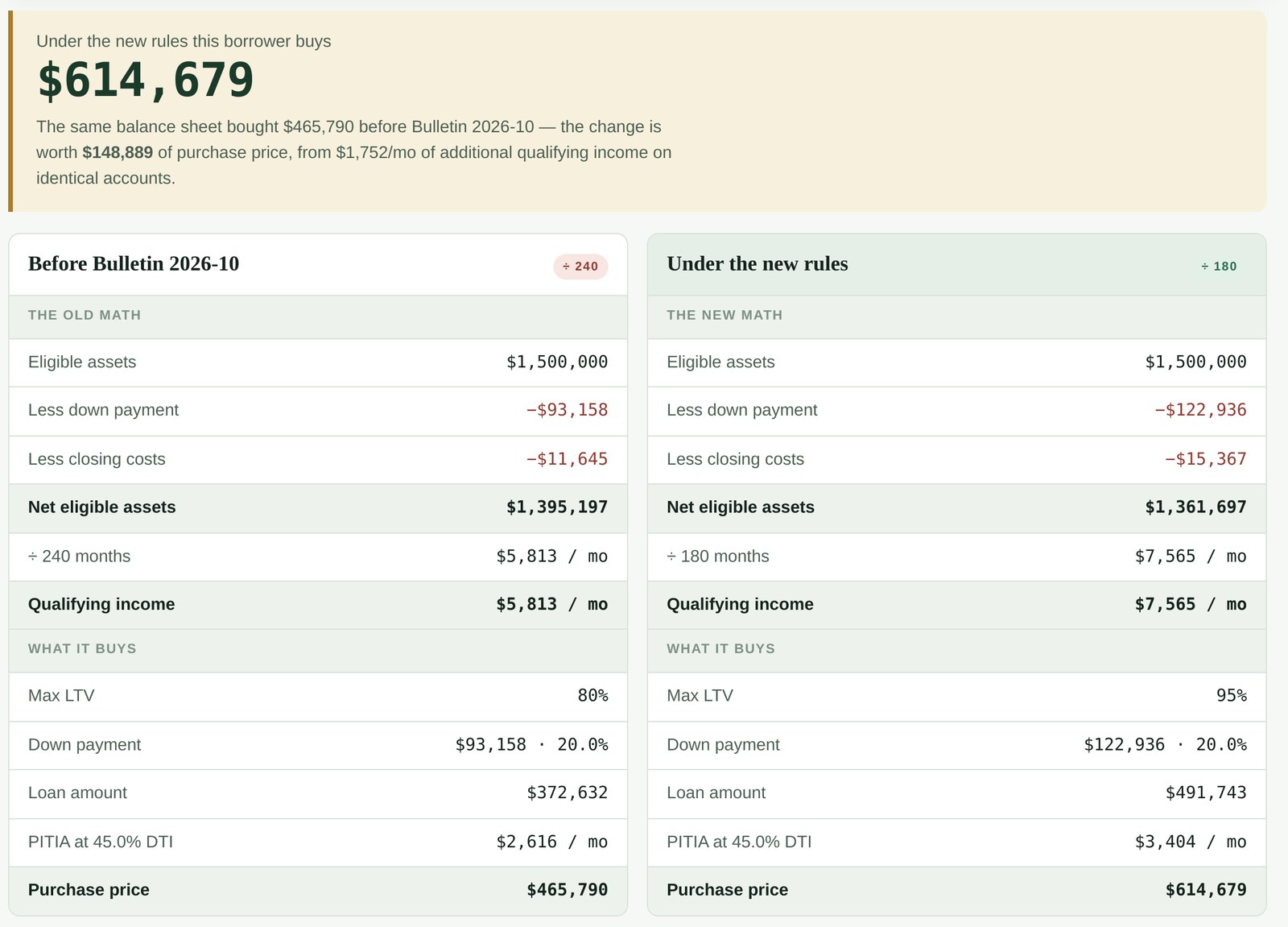
On August 5, 2026 Freddie Mac issued Bulletin 2026-10 and rewrote the rule that lets a borrower qualify on savings instead of a paycheck. The division factor dropped from 240 months to 180, and the 80% loan-to-value ceiling that had capped these loans for years was removed entirely. A borrower with $1.5 million in accounts who qualified for a $465,790 house in July qualifies for $614,679 today, on the same balance sheet and the same rate.
The change is mandatory for settlement dates on or after February 3, 2027. Lenders are permitted to implement it immediately, which means the answer you get right now depends entirely on which lender you ask.
What Freddie Mac changed
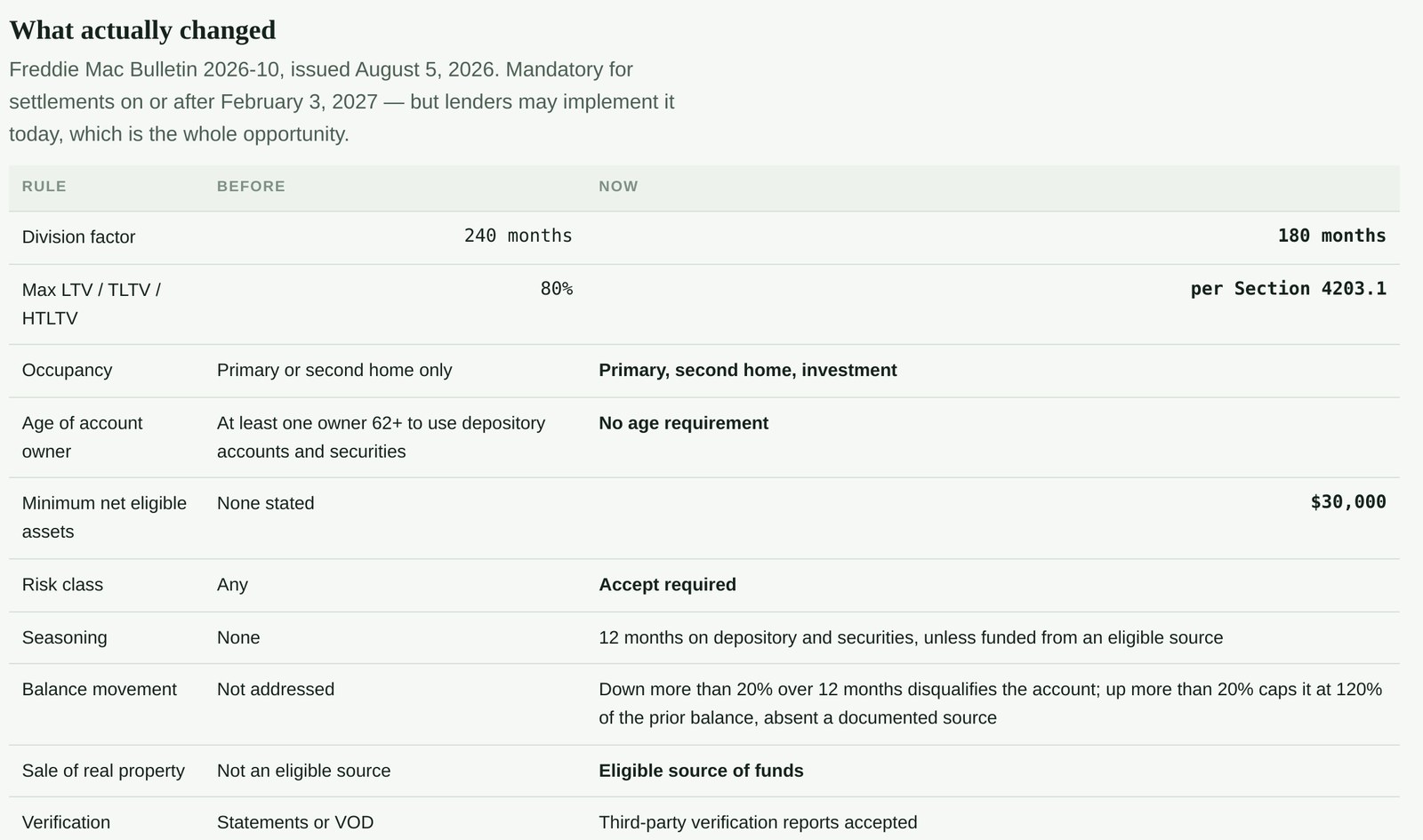
The rule lives in Guide Section 5307.1, "Assets as a basis for repayment of obligations." Ten things moved.
- The division factor went from 240 to 180. Same assets, 33% more qualifying income.
- The 80% LTV cap is gone. Maximum LTV, TLTV and HTLTV now follow the standard limits in Section 4203.1, so 95% on a conventional purchase.
- Every occupancy type is eligible. Primary residences, second homes and, for the first time, investment properties.
- The age 62 requirement was removed. The old rule would not let you use a checking, savings or brokerage account unless at least one borrower who owned it was 62 or older.
- A $30,000 minimum in net eligible assets now applies.
- The loan must receive an Accept from Loan Product Advisor.
- Depository accounts and securities must be seasoned 12 months before the note date, unless the account was funded from a source the guide recognizes.
- Balance movement is now tested. An account that fell more than 20% over the prior 12 months is not eligible at all, unless the drop is documented as a transfer into securities or retirement. An account that rose more than 20% is capped at 120% of what it held a year ago, unless the increase is traced to a documented source.
- Proceeds from selling real property became an eligible way to fund the account.
- Third-party verification reports are now accepted as documentation.
How the qualifying income is calculated
Three steps, and the middle one is the one people forget.
- Total the eligible documented assets.
- Subtract everything the borrower has to bring to closing, which means the down payment and the closing costs, plus any gift funds, borrowed funds, or assets pledged as collateral.
- Divide what is left, the "net eligible assets," by 180.
The money used to buy the house cannot also be the money that produces the income. That is why a larger down payment does not automatically buy more house under this rule, and why the calculator below holds the down payment steady when it compares the two rulebooks.
Take $1.5 million spread across a $150,000 checking balance, a $500,000 brokerage account and $850,000 in retirement, with 20% down on the purchase. About $104,800 leaves for the down payment and closing costs under the old math, leaving $1,395,197. Divided by 240, that is $5,813 a month. Under the new math the same borrower puts down more because the house is bigger, so $1,361,697 survives, and divided by 180 it produces $7,565 a month. Nothing about the accounts changed. The income went up $1,752 a month because the denominator moved.
Which assets count
Four categories qualify, and Freddie counts them at full value. There is no haircut, which is the detail most people get wrong because Fannie Mae's separate rule for employment-related assets discounts what it accepts.
Retirement accounts recognized by the IRS, such as a 401(k) or an IRA. The borrower has to be the sole owner, fully vested, and able to withdraw the entire balance as of the note date without a penalty or an additional early-distribution tax. In practice that means 59 and a half for most account types, and it is the reason a 57-year-old with a large 401(k) still cannot use it. The account also cannot already be a source of income the borrower is drawing on.
Depository accounts and securities. Checking, savings, brokerage. The borrower must own them outright, or jointly with someone who is also on the loan or on title. Funds have to sit in a United States or state-regulated institution and be verified in dollars. Any deposit larger than 10% of total eligible assets has to be sourced, and if it turns out to be a gift or borrowed money it comes back out of the qualifying figure.
Lump-sum distributions from a retirement account that were deposited somewhere other than another retirement account, as long as they were never subject to a penalty or early distribution tax and the proceeds are immediately accessible.
Proceeds from selling a business, which must have been deposited into a depository or securities account and held there for at least 90 days, with the closing documents and the pre-sale business return in the file. Proceeds from selling real property are now eligible as well, which is new with this bulletin.
Cryptocurrency is excluded outright, in every category.
The change nobody is talking about
The 240 to 180 headline is real, but the removal of the age 62 requirement may matter more.
Under the old rule, a borrower who was not yet 62 could not use a checking, savings or brokerage account as qualifying income at all. If they were also under 59 and a half, the retirement accounts were out too. So a 58-year-old sitting on $1.5 million qualified for nothing under this section, no matter how the money was arranged.
That same 58-year-old can now use the $650,000 outside the retirement plan. The retirement money still waits until the penalty goes away, but the door is no longer locked. Early retirees, people who sold a business in their fifties, and anyone living off a portfolio before traditional retirement age were the group this rule quietly excluded, and they are the group it just admitted.
What it does to buying power
Two rule changes stack, and they compound in different directions.
The divisor gives you more income. The LTV change lets you keep more of the money that produces it. Before the bulletin, an asset-qualified borrower had to put 20% down no matter how large the accounts were, and every one of those dollars came out of the pile being divided. At 5% down the same $1.5 million now supports a $533,382 purchase, and the old rulebook does not permit that purchase at any price, because 95% financing simply was not available on this program.
The investment property change opens a different door. An investor with a portfolio and thin documentable income was locked out of this section entirely. At 25% down, the example above supports $634,036 on a rental.
Can you use it on a 97% Home Possible loan?
Probably, and the bulletin points that way. The new section defers to the ratios in Section 4203.1 rather than setting its own ceiling, and Section 4501.4, which governs Home Possible, appears in the bulletin's own list of updated sections.
There is a catch worth checking before anyone plans around it. Home Possible limits qualifying income to 80% of the area median, and income produced from assets counts toward that limit. Push the asset balances high enough to buy a large house and you can price yourself out of the program that allowed the small down payment. The calculator flags the annual figure so you can test it against the tract.
The guardrails are real
This is not a loosening in every direction. Freddie added tests that did not exist before, and they will catch files that would have sailed through last month.
The 12-month seasoning requirement means an account opened this spring does not count yet unless the money came from somewhere the guide recognizes. The balance-movement test is stricter than it sounds: an account that dropped more than 20% over the past year is disqualified outright unless the decline is documented as a transfer into securities or retirement, so a borrower who spent down a brokerage account to renovate a house has a problem. On the other side, a large recent deposit gets capped rather than counted, unless it traces back to a retirement transfer, another qualifying account, a lump sum, or the sale of a business or property.
And the file has to run Accept. A Caution with compensating factors does not get there.
When you can actually use it
February 3, 2027 is the mandatory date. Immediate adoption is optional, and that is where this gets practical: two lenders looking at identical statements this month can return answers $150,000 apart, purely on whether they have implemented the new section yet.
That is worth knowing before you shop. If you are working with someone who has not asked their lender the question, they will quote you the old number and neither of you will know what was left on the table.
Who this fits in Colorado
We see the same profiles along the Front Range. A retired couple in Monument with a paid-off house and a seven-figure IRA, whose tax return shows almost nothing. A military retiree in Colorado Springs with a TSP balance and a pension too small to carry the payment on its own. Someone who sold a business in Denver and has not drawn a salary in two years. A parent buying near the grandkids who has the money but not the W-2.
Every one of them has been told, correctly until this month, that the assets were worth less than they look. That answer changed on August 5.
Frequently Asked Questions
What did Freddie Mac Bulletin 2026-10 change about using assets as income?
How is qualifying income calculated from assets under Section 5307.1?
Which assets can be used as qualifying income?
Do you have to be 62 to use assets as income?
Can asset income be used on a 97% Home Possible loan?
When can lenders start using the new asset depletion rules?
Find out what your accounts actually qualify for
Send the statements and we will run them under the new Section 5307.1, tell you what the seasoning and balance-movement tests do to them, and confirm whether the lender we place you with has adopted the change yet. No credit pull to start.
Book a Gain Clarity call